How do you convert meteorological wind direction into u and v?
For wind speed S and meteorological direction θ, use u = −S sin θ and v = −S cos θ. Direction is measured clockwise from north and describes where the wind comes from. Positive u points east and positive v points north.
Start with Bulk wind shear vector practice for a turning wind profile.
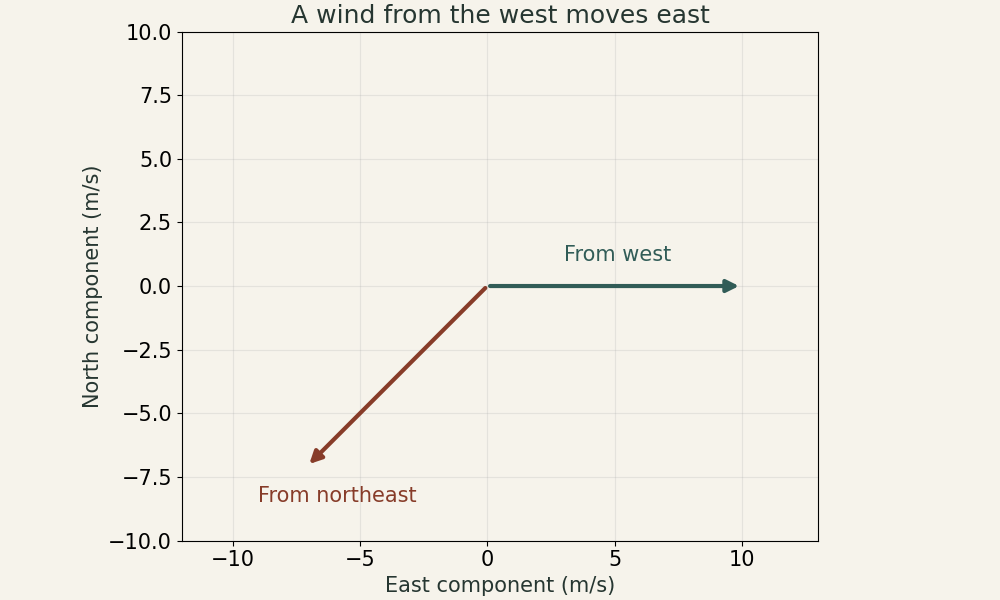
| Direction from | Speed | Component (u, v) in m/s |
|---|---|---|
| 270° | 10 m/s | (+10, 0) |
| 180° | 10 m/s | (0, +10) |
| 45° | 10 m/s | (−7.07, −7.07) |
Worked example
Draw a compass with north up and east to the right. For a 10 m/s wind from 270°, the arrow travels from west toward east. Since sin 270° = −1 and cos 270° = 0, u = +10 m/s and v = 0. For a southeast wind, both component signs change relative to a northwest wind.
Hint for the exercises
Draw where the air comes from, then point the velocity arrow away from that direction.
Practice questions
- Find u and v for the 270° wind.
- Find u and v for an 8 m/s northerly wind.
- Find the components of a 10 m/s wind from 135°.
- What meteorological direction corresponds to (6,8) m/s? Round to the nearest degree.
- A calculator gives a nonzero northward component for an exactly westerly wind. What setting should you check?
- Can you infer the direction from a vector with u = v = 0?
Worked answers
Answer 1
u = −10(−1) = +10 m/s. v = 0.
Answer 2
u = 0 and v = −8 m/s.
Answer 3
u = −10 sin 135° ≈ −7.07 m/s. v = −10 cos 135° ≈ +7.07 m/s.
Answer 4
The flow goes northeast with bearing arctan(6/8) ≈ 37°. Its source direction is about 217° and its speed is 10 m/s.
Answer 5
Check the degree versus radian setting first. Small floating-point residuals close to zero are also possible.
Answer 6
No. This is calm wind and the vector has no direction.
- u = −10(−1) = +10 m/s. v = 0.
- u = 0 and v = −8 m/s.
- u = −10 sin 135° ≈ −7.07 m/s. v = −10 cos 135° ≈ +7.07 m/s.
- The flow goes northeast with bearing arctan(6/8) ≈ 37°. Its source direction is about 217° and its speed is 10 m/s.
- Check the degree versus radian setting first. Small floating-point residuals close to zero are also possible.
- No. This is calm wind and the vector has no direction.