How does the Bunkers method estimate right-moving supercell motion?
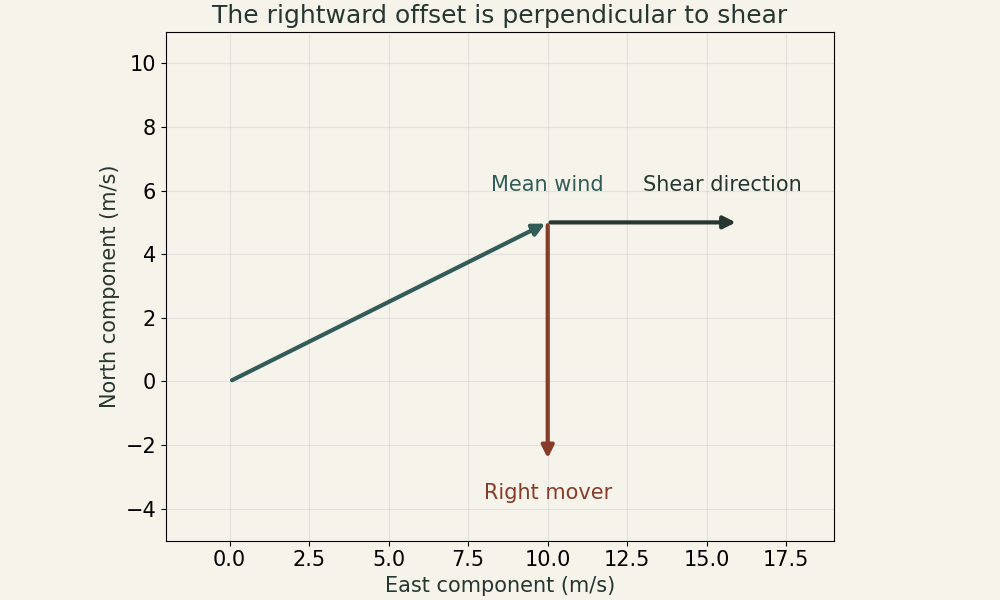
The Bunkers method places a right-moving supercell on the right side of the deep shear vector by adding a perpendicular offset to a deep-layer mean wind. The reference offset magnitude is 7.5 m/s.
Start with Bulk wind shear vector practice for a turning wind profile.
| Quantity | East component (m/s) | North component (m/s) |
|---|---|---|
| Mean wind | 10 | 5 |
| Right deviation | 0 | −7.5 |
| Right mover | 10 | −2.5 |
| Left mover | 10 | 12.5 |
Set up the experiment
Use a surface-to-6 km mean wind and the shear from the mean surface-to-0.5 km winds to the mean 5.5-to-6 km winds. For this synthetic experiment, prescribe those means before calculating. Let the deep mean be (10,5) m/s and shear point due east. Predict which component will change. Eastward shear has a southward right side, so add (0,−7.5) for right-mover (10,−2.5) m/s. A left mover adds the opposite offset. This method estimates motion from a profile. Any observed storm can deviate from that estimate.
Practice questions
- Keep the mean wind fixed and rotate the shear vector due north. Find the right mover.
- With eastward shear, what is the vector difference between the right and left movers?
- What happens if the prescribed shear vector has zero magnitude?
Worked answers
Answer 1
Right of north is east. Add (7.5,0) to get (17.5,5) m/s.
Answer 2
Right minus left is (0,−15) m/s. The offsets have equal size and opposite directions.
Answer 3
Its perpendicular unit vector is undefined. The shear-relative offset cannot be constructed from that vector.
- Right of north is east. Add (7.5,0) to get (17.5,5) m/s.
- Right minus left is (0,−15) m/s. The offsets have equal size and opposite directions.
- Its perpendicular unit vector is undefined. The shear-relative offset cannot be constructed from that vector.