How does storm-motion error shift a supercell track forecast?
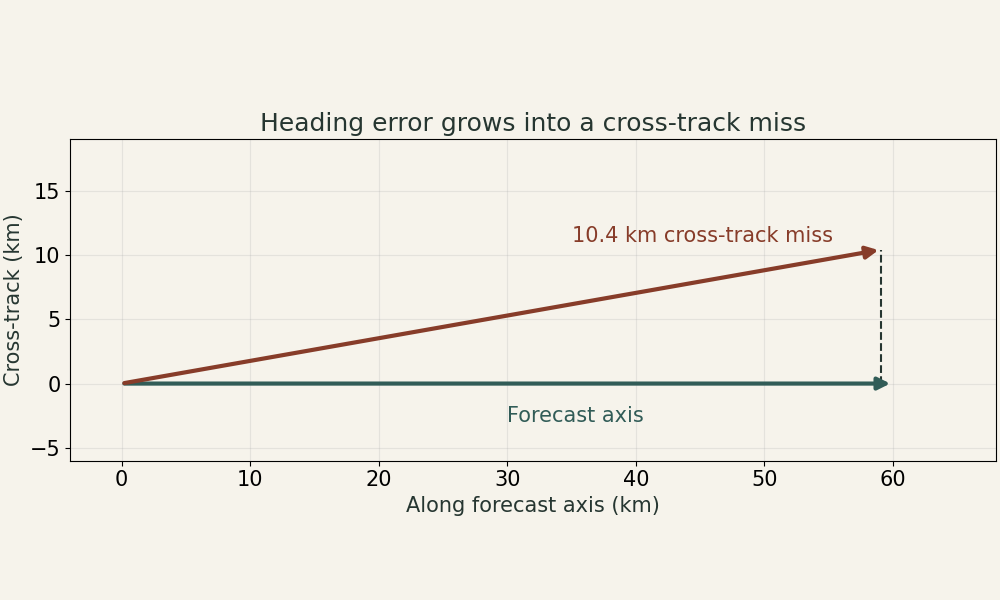
For equal travel distances and an angular track error, cross-track miss distance is the travel distance times the sine of the heading difference. A small angle matters more at longer lead times.
Start with How far will a moving supercell travel between two radar scans?.
| Travel distance | Heading difference | Cross-track miss |
|---|---|---|
| 30 km | 10° | 5.2 km |
| 60 km | 10° | 10.4 km |
| 120 km | 10° | 20.8 km |
Set up the experiment
Fix a flat local map and measure cross-track distance perpendicular to the predicted straight track. Use the same speed and starting point for both paths. Before calculating, predict which lead time produces the larger miss. If a storm travels L = 60 km on a course 10° off the prediction, |cross-track miss| = 60 sin 10° ≈ 10.4 km. This isolates heading error. Speed error, changing storm structure and curvature can add other displacement components.
Practice questions
- If the storm travels 60 km at 5° off the predicted heading, find the miss.
- At 60 km and 10°, how far along the predicted axis has the storm traveled?
- What if the heading is correct but speed differs?
Worked answers
Answer 1
60 sin 5° ≈ 5.23 km.
Answer 2
60 cos 10° ≈ 59.09 km, about 0.91 km short of the predicted endpoint along that axis.
Answer 3
Cross-track error from heading is zero. The endpoints can still differ along the predicted axis.
- 60 sin 5° ≈ 5.23 km.
- 60 cos 10° ≈ 59.09 km, about 0.91 km short of the predicted endpoint along that axis.
- Cross-track error from heading is zero. The endpoints can still differ along the predicted axis.