CAPE integration practice with a three-level sounding
Calculate CAPE by integrating a piecewise-linear buoyancy profile. Work six problems with hints and step-by-step solutions.
Convective available potential energy (CAPE) is the integral of positive parcel buoyancy through its free-convection layer. For a three-level exercise, multiply each height interval by its mean buoyancy and add the areas. The result is measured in joules per kilogram.
Prerequisite. Review CAPE and CIN.
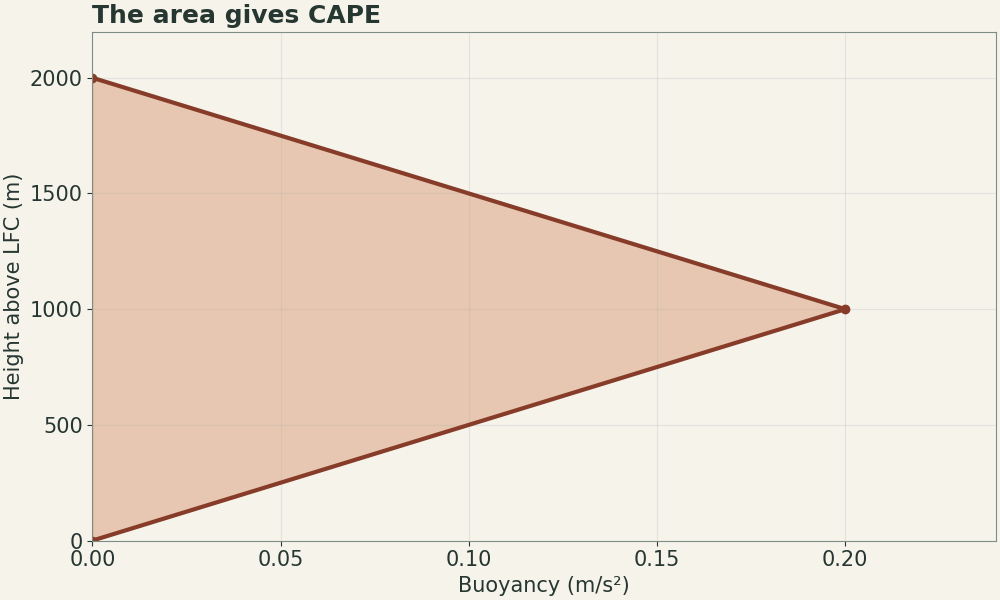
| Height (m) | Buoyancy (m/s²) |
|---|---|
| 0 | 0 |
| 1,000 | 0.20 |
| 2,000 | 0 |
Integrate the buoyancy profile
Let B be upward buoyancy acceleration in m/s² and z be height in metres. Approximate the profile as linear between observations. The area of each trapezoid is Δz × (B₁ + B₂) / 2. Because m × m/s² equals m²/s², each area is energy per unit mass. If a layer crosses B = 0, find the crossing first and use the positive portion for this exercise. The negative area below the LFC relates to inhibition.
Practice questions
- Use the table to find CAPE.
Hint
Treat the profile as two triangles. - Find CAPE if peak buoyancy rises to 0.30 m/s² and the layer heights stay the same.
Hint
Scale the triangle areas by the peak change. - Find CAPE for B = (0, 0.20, 0) m/s² at z = (0, 500, 2,000) m.
Hint
Use two different layer thicknesses. - In a synthetic ascent B rises linearly from −0.10 to +0.10 m/s² in 1,000 m. Find the positive contribution.
Hint
Find B = 0 before integrating. - A classmate integrates using heights 0, 1 and 2 km and reports 0.20 J/kg. Fix the result.
Hint
Write out the distance unit. - Two profiles have 200 J/kg of CAPE. Must their peak buoyancy be equal?
Hint
Compare the areas of triangles with different widths.
Worked answers
Answer 1
Each area is 1,000 × 0.20 / 2 = 100 J/kg. Total CAPE = 200 J/kg.
Answer 2
Each area becomes 150 J/kg, so total CAPE = 300 J/kg.
Answer 3
Areas are 500 × 0.10 = 50 and 1,500 × 0.10 = 150 J/kg. Total = 200 J/kg.
Answer 4
The zero crossing is at 500 m. Positive area = 500 × 0.10 / 2 = 25 J/kg.
Answer 5
The unconverted answer uses kilometres. Multiply by 1,000 m/km to obtain 200 J/kg.
Answer 6
A triangular profile with base 4 km and peak 0.10 m/s² also has 200 J/kg. Peak buoyancy can differ at equal integrated area.
- Each area is 1,000 × 0.20 / 2 = 100 J/kg. Total CAPE = 200 J/kg.
- Each area becomes 150 J/kg, so total CAPE = 300 J/kg.
- Areas are 500 × 0.10 = 50 and 1,500 × 0.10 = 150 J/kg. Total = 200 J/kg.
- The zero crossing is at 500 m. Positive area = 500 × 0.10 / 2 = 25 J/kg.
- The unconverted answer uses kilometres. Multiply by 1,000 m/km to obtain 200 J/kg.
- A triangular profile with base 4 km and peak 0.10 m/s² also has 200 J/kg. Peak buoyancy can differ at equal integrated area.