How sensitive is ideal updraft speed to a small CAPE error?
Measure how ideal updraft speed changes with CAPE, verify the derivative against the simulator, and solve three transfer problems.
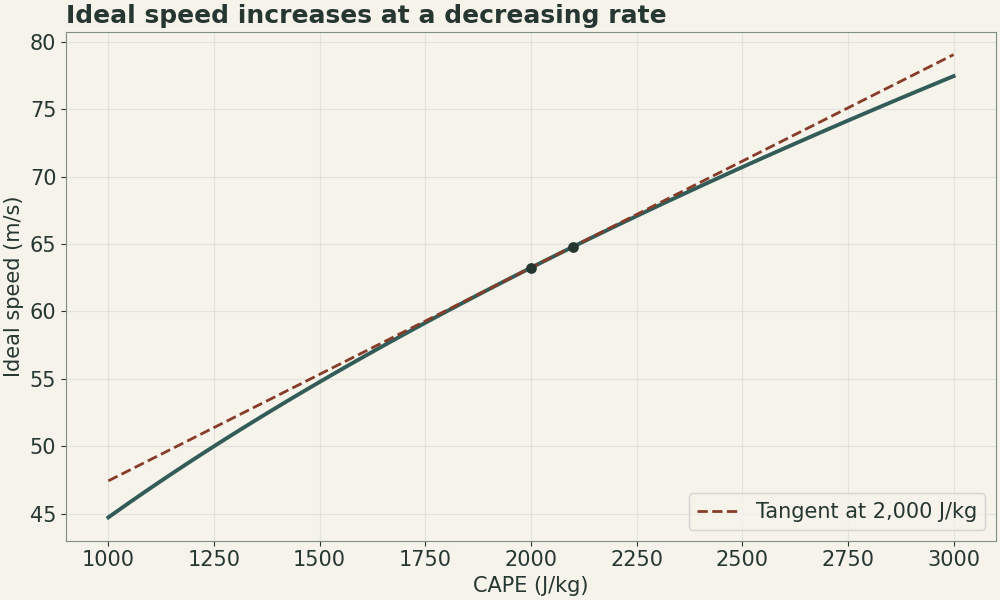
At 2,000 J/kg of CAPE, a small increase of 100 J/kg raises the ideal parcel speed by about 1.56 m/s. The derivative predicts about 1.58 m/s. Comparing the two shows how closely a linear estimate follows the square-root relationship over that interval.
Prerequisite. Review ideal updraft speed.
| CAPE (J/kg) | Ideal speed (m/s) | Simulator |
|---|---|---|
| 2,000 | 63.25 | Run baseline |
| 2,100 | 64.81 | Run with +100 J/kg |
Predict, run and compare
Set CIN to −50 J/kg, shear to 45 kt, storm-relative helicity to 150 m²/s², cloud base to 1,000 m and surface dewpoint to 68°F. Predict whether the second run will gain more or less than 2 m/s, then compare the ideal speed readouts. The simulator rounds its display, so use the unrounded equation for the difference.
Derive the local slope
For an ideal parcel starting from rest, set kinetic energy per mass, w²/2, equal to CAPE C. From w = √(2C), differentiation gives dw/dC = 1/√(2C) for C > 0. At C = 2,000 J/kg, multiply ΔC by this slope to predict 100/√4000 = 1.5811 m/s. Direct calculation gives √4200 − √4000 = 1.5619 m/s, a difference of about 0.019 m/s.
The result assumes lossless conversion of buoyancy work into parcel kinetic energy. Mixing, condensate loading and pressure perturbations affect observed vertical motion.
Practice questions
- Repeat the derivative estimate at 500 J/kg for the same 100 J/kg change.
- What happens at C = 0 when C increases to 50 J/kg?
- At 2,000 J/kg, predict a 100 J/kg decrease and compare it with the equal increase.
Worked answers
Answer 1
100/√1000 ≈ 3.16 m/s. The exact difference √1200 − √1000 is about 3.02 m/s.
Answer 2
The exact ideal speed rises from zero to 10 m/s. The derivative formula is undefined at exactly zero.
Answer 3
The linear estimate is −1.58 m/s. The direct decrease is √3800 − √4000 ≈ −1.60 m/s. The square root steepens toward lower CAPE.
- 100/√1000 ≈ 3.16 m/s. The exact difference √1200 − √1000 is about 3.02 m/s.
- The exact ideal speed rises from zero to 10 m/s. The derivative formula is undefined at exactly zero.
- The linear estimate is −1.58 m/s. The direct decrease is √3800 − √4000 ≈ −1.60 m/s. The square root steepens toward lower CAPE.