How do you locate an LFC or equilibrium level between sounding levels?
An LFC candidate lies where parcel buoyancy changes from negative to positive. An equilibrium level candidate lies where buoyancy changes from positive to negative. Between sampled heights, a simple exercise estimates the crossing by linear interpolation.
Start with How do you calculate parcel buoyancy using virtual temperature?.
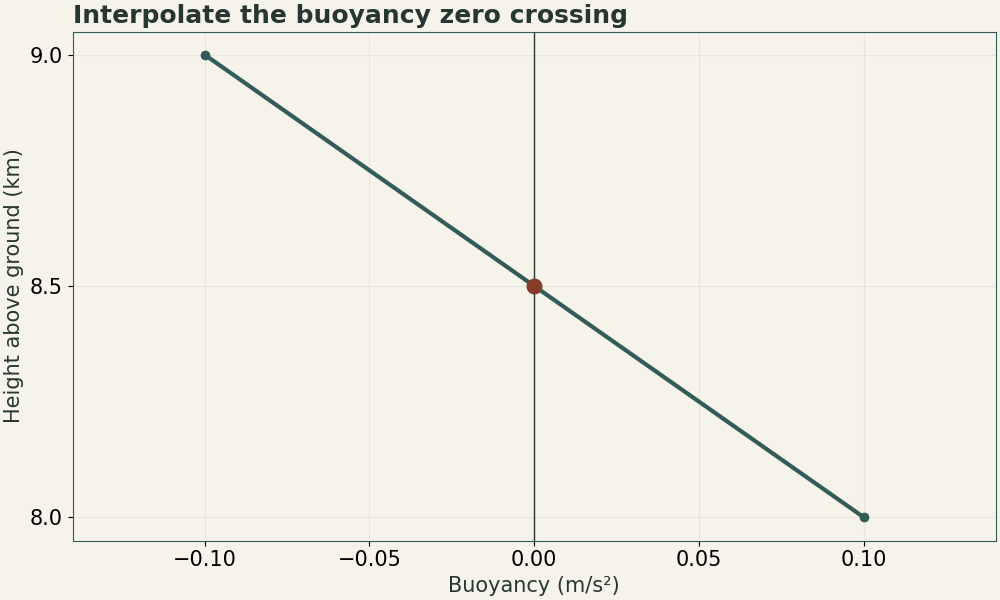
| Height above ground (km) | Parcel buoyancy (m/s²) |
|---|---|
| 8.0 | +0.10 |
| 8.5 | 0, interpolated |
| 9.0 | −0.10 |
Worked example
Let z₁ and z₂ be the bounding heights and B₁ and B₂ their buoyancies. The fraction from the lower point to the zero crossing is −B₁/(B₂−B₁). For +0.10 and −0.10 m/s² at 8 and 9 km, that fraction is 0.50. The crossing is at 8.5 km and has the sign transition associated with an equilibrium level. Actual soundings may have several crossings. State the parcel, height reference and selection rule when reporting a single level.
Practice questions
- Find the crossing for −0.02 and +0.06 m/s² at 1 and 2 km. Which transition is it?
- Both samples are positive. Can the assumed linear segment contain a zero?
Worked answers
Answer 1
The fraction is 0.02/0.08 = 0.25, giving 1.25 km. It is a negative-to-positive crossing and an LFC candidate.
Answer 2
No. A linear segment between two strictly positive endpoints stays positive. A finer observed profile could reveal structure unresolved by these two samples.
- The fraction is 0.02/0.08 = 0.25, giving 1.25 km. It is a negative-to-positive crossing and an LFC candidate.
- No. A linear segment between two strictly positive endpoints stays positive. A finer observed profile could reveal structure unresolved by these two samples.