How do you calculate convective inhibition from negative buoyancy?
Calculate signed CIN by integrating negative buoyancy along the parcel ascent below its level of free convection. The magnitude describes how much energy per kilogram a lifting mechanism must overcome in this idealized calculation.
Start with CAPE integration practice with a three-level sounding.
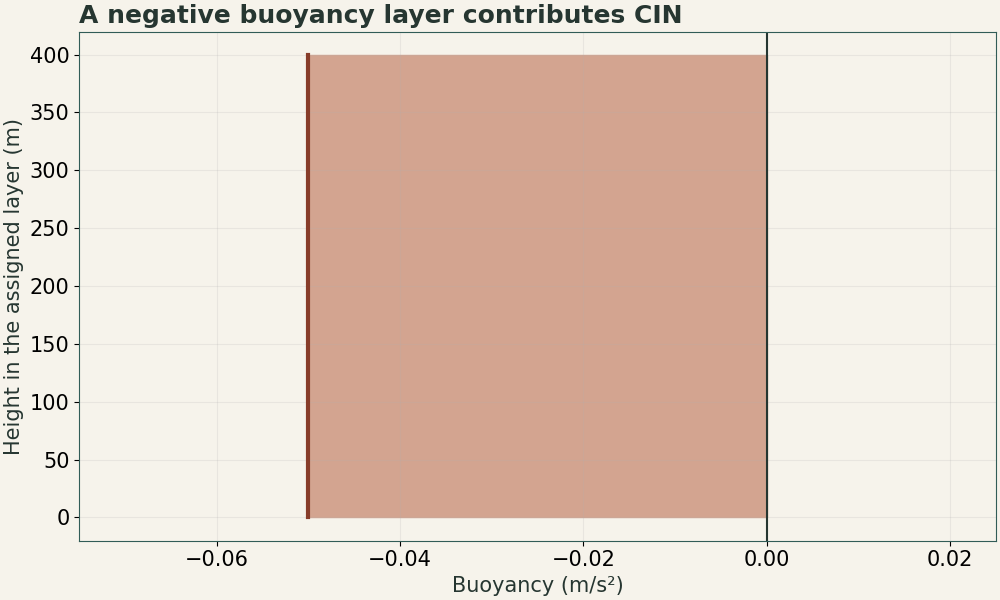
| Layer (m) | Buoyancy (m/s²) | Signed area (J/kg) |
|---|---|---|
| 0–400 | −0.05 | −20 |
Worked example
A 400 m cap has constant buoyancy B = −0.05 m/s². Use signed area B × Δz = −20 m²/s² = −20 J/kg. Its inhibition magnitude is 20 J/kg. When the endpoints differ, use their mean for a linear profile. If a layer crosses zero, interpolate the crossing before summing negative portions. The assigned profile uses height integration. Operational sounding tools may compute with pressure coordinates.
Hint for the exercises
Draw the negative part of the profile and convert each altitude interval into metres before integrating.
Practice questions
- Find signed CIN and its magnitude for the worked cap.
- Double the cap thickness at the same buoyancy.
- Sum a 200 m layer at −0.03 m/s² and a 300 m layer at −0.08 m/s².
- Buoyancy increases linearly from −0.06 to +0.06 m/s² over 600 m. Find the negative contribution.
- A classmate gets −0.020 J/kg by using 0.4 km as the thickness of the worked cap. Correct the result.
- Can profiles with equal CAPE have different CIN?
Worked answers
Answer 1
−0.05 × 400 = −20 J/kg. Its magnitude is 20 J/kg.
Answer 2
−0.05 × 800 = −40 J/kg. Its magnitude is 40 J/kg.
Answer 3
The contributions are −6 and −24 J/kg, so the signed sum is −30 J/kg.
Answer 4
The crossing is at 300 m. Average the negative endpoint and zero to obtain −0.03 m/s², then multiply by 300 m for −9 J/kg.
Answer 5
Convert 0.4 km to 400 m. Multiplying by −0.05 m/s² gives −20 J/kg.
Answer 6
Yes. CAPE depends on positive buoyancy above the LFC. Changing the negative layer below the LFC can change CIN while leaving the positive area intact.
- −0.05 × 400 = −20 J/kg. Its magnitude is 20 J/kg.
- −0.05 × 800 = −40 J/kg. Its magnitude is 40 J/kg.
- The contributions are −6 and −24 J/kg, so the signed sum is −30 J/kg.
- The crossing is at 300 m. Average the negative endpoint and zero to obtain −0.03 m/s², then multiply by 300 m for −9 J/kg.
- Convert 0.4 km to 400 m. Multiplying by −0.05 m/s² gives −20 J/kg.
- Yes. CAPE depends on positive buoyancy above the LFC. Changing the negative layer below the LFC can change CIN while leaving the positive area intact.