Do All Supercells Produce Tornadoes?
Learn the difference between a mesocyclone and a tornado, how non-tornadic supercells cause damage, and what a hook echo can tell you.
No. A supercell has a sustained rotating updraft, and many supercells never produce a tornado. A tornado is a much narrower circulation that reaches the ground. Tornadoes and damaging wind are two different ways the same parent storm can affect the surface.
Even when a supercell stays non-tornadic, very large hail, damaging winds, heavy rain and lightning can make it dangerous.
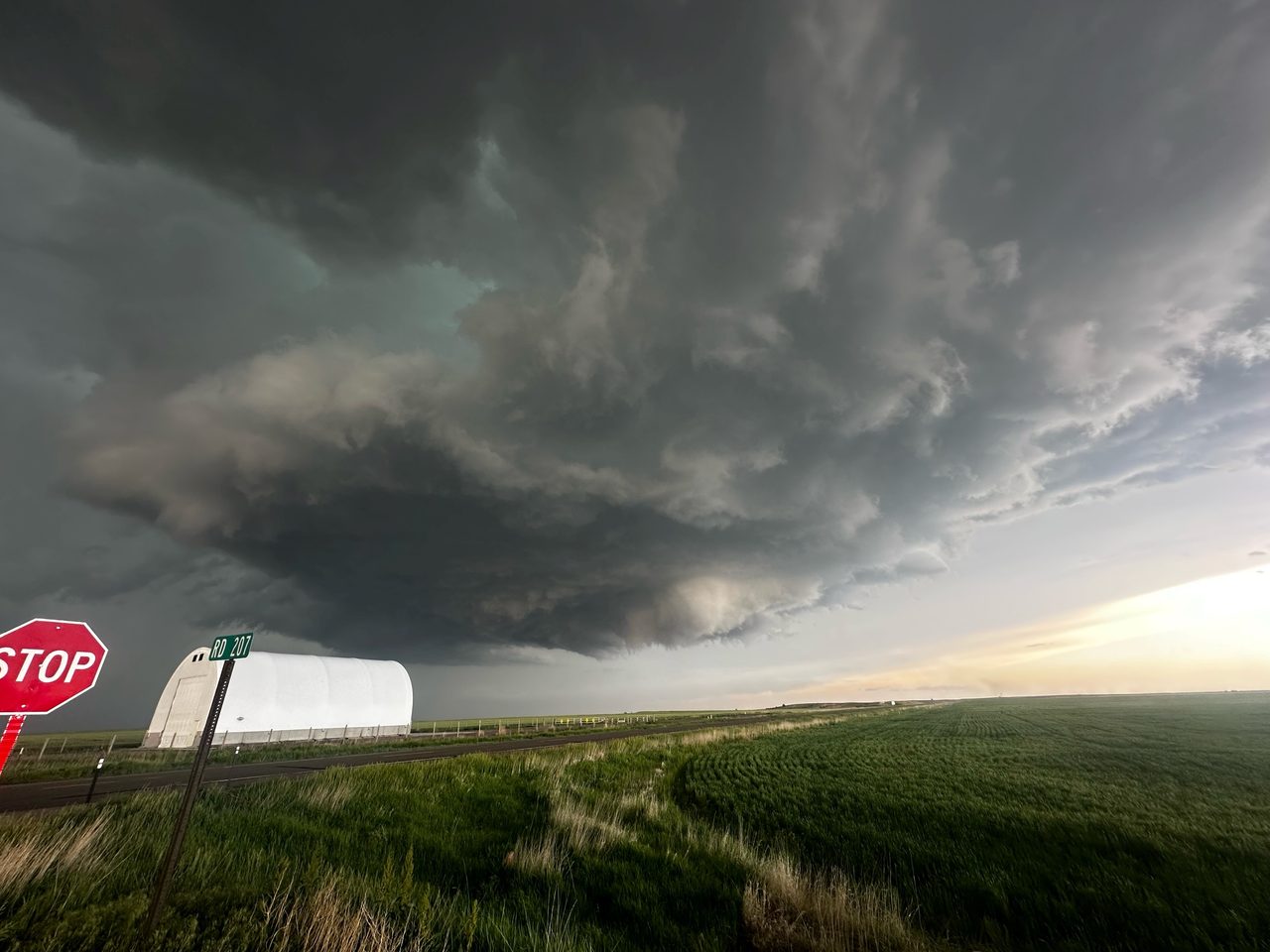
Mesocyclone, funnel cloud and tornado
| Feature | What it describes |
|---|---|
| Mesocyclone | Storm-scale rotation in the updraft. Radar may observe it well above ground. |
| Funnel cloud | A visible cone of condensation. Tornado circulation can extend beyond the visible funnel. |
| Tornado | A rotating column of air in contact with the ground and connected to a convective cloud. |
What does a hook echo tell you?
A hook echo is a curved pattern of precipitation on radar reflectivity. It can show precipitation wrapping around a storm's circulation. Meteorologists also look at Doppler velocity, radar sampling height and reports from the ground. A single reflectivity image gives an incomplete picture.
What can a supercell do without a tornado?
In July 2022, investigators near Thedford, Ontario, documented damage from a downburst in a supercell. Intensifying winds from a descending pocket of air spread near the surface. A single photograph of trees or roof damage rarely resolves the cause. Investigators use damage patterns, radar and other observations together.
Compare the rotating updraft and descending air in the supercell cross-section exercise. During a warning, follow official instructions for your location.