Supercells in Southern Ontario
Yes, supercells form in Southern Ontario. See how Great Lakes breezes influence storm development, with documented cases from Toronto, Barrie and Thedford.
Yes, Southern Ontario gets supercells. When instability and wind shear overlap, storms can develop a rotating updraft anywhere the local setup supports it. In southwestern Ontario, breezes from Lake Huron and Lake Erie can add boundaries that help lift warm air.
A lake breeze can also bring cooler air inland. Where a storm sits relative to the boundary matters more than simple distance from the shore.
How do the Great Lakes affect storm formation?
On a warm day, land often heats faster than water. Cooler air pushes inland from the lake and meets warmer air along a lake-breeze front. Air converges there and can rise. In field observations, researchers tracked where southwestern Ontario storms began relative to lake breezes and other low-level boundaries. A boundary can help a thunderstorm start. A sustained rotating updraft also needs a suitable wind profile.
Three documented Southern Ontario examples
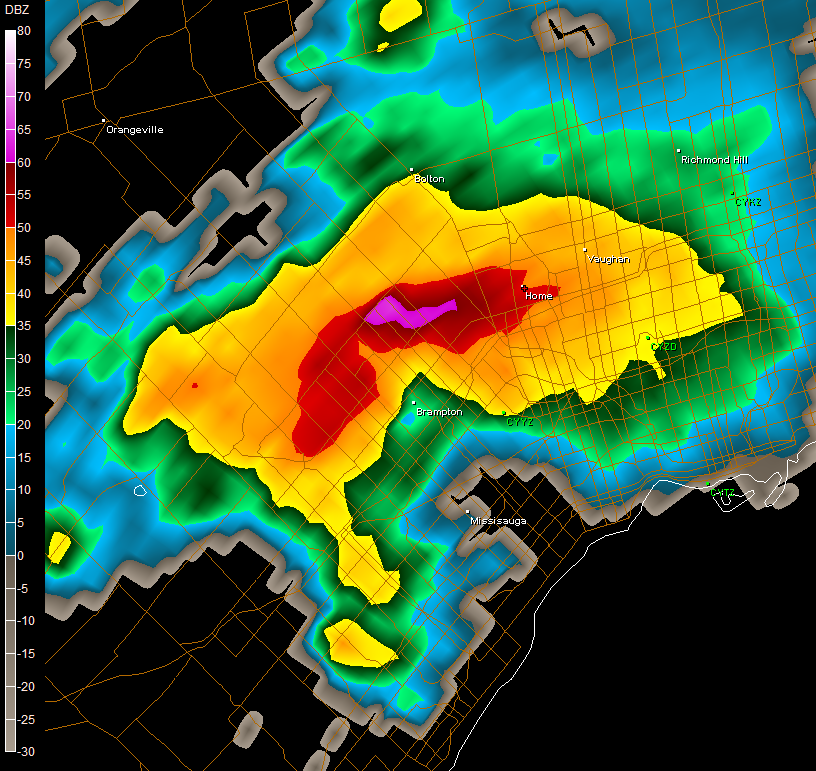
- Toronto, August 19, 2005. The archived radar image below shows a supercell affecting the Toronto area. Heavy rain also caused extensive flooding in North Toronto.
- Barrie, July 15, 2021. ECCC confirmed an EF2 tornado with a 12.5-kilometre surveyed damage track and estimated maximum winds of 210 km/h.
- Near Thedford, July 20, 2022. Western University's Northern Tornadoes Project attributed surveyed wind damage to a downburst in a supercell's rear-flank downdraft. Rotating storms can cause severe straight-line wind damage.
When should I pay attention?
Thunderstorms are common in the warm months. A summer afternoon alone tells you very little about storm type. Look at the broader forecast and official alerts. You can explore the difference between buoyancy and shear in the supercell simulator and use Ontario’s tornado history for local context.
Open the live radar monitor focused on Southern Ontario. For current alerts, use Environment and Climate Change Canada’s Ontario warnings.