How Long Do Supercells Last?
Some supercells last several hours. Learn what sustains them and why the lifetime of the thunderstorm differs from how long it affects your town.
A supercell can last several hours when its rotating updraft keeps drawing in buoyant air. A town along the track may experience only a short part of that lifetime. Any tornado produced by the storm has its own start and end times.
Duration depends on how well the storm stays organized and what air it moves into. Weather radar loops let you follow that evolution across successive scans.
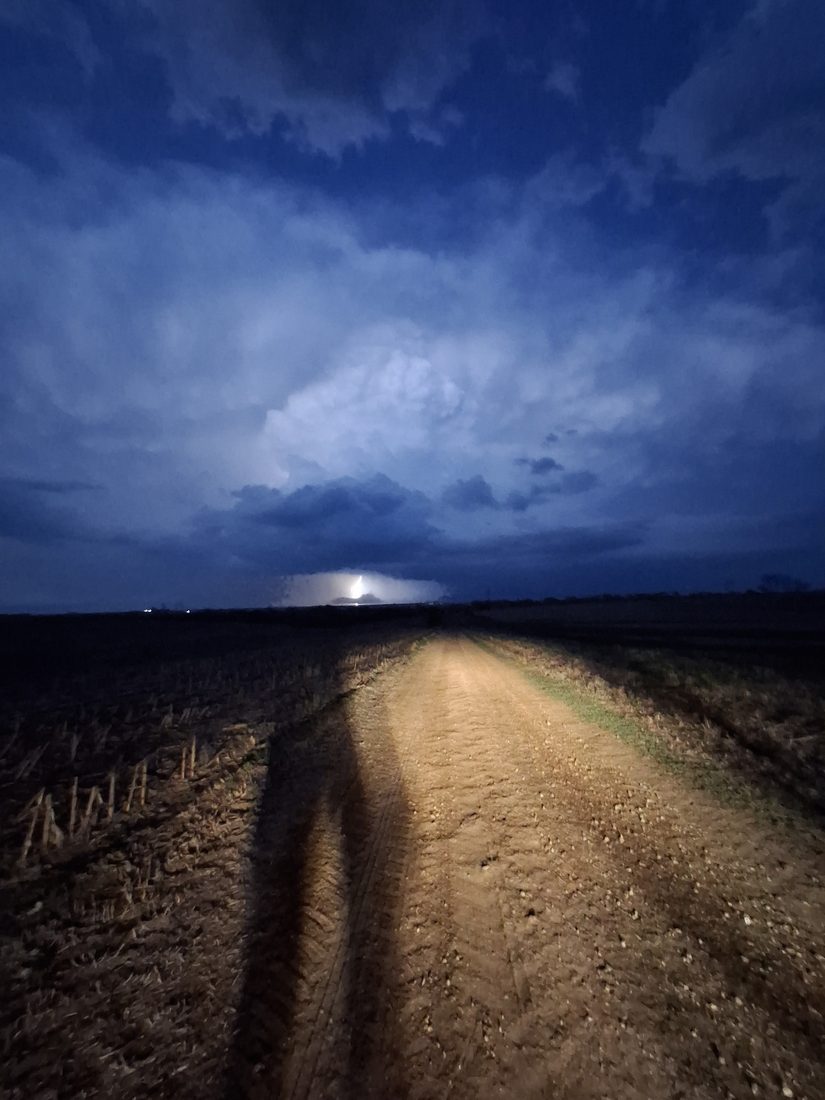
What keeps a supercell alive?
Vertical wind shear helps separate the rising air that feeds the storm from rain and hail falling elsewhere. That separation can keep cool outflow from undercutting the updraft right away. Some supercells cycle through changes in where their strongest rotation sits. A weakening circulation can be followed by renewed rotation elsewhere in the same parent storm.
Storm lifetime and time over one town
Suppose a storm’s rain core is roughly 15 kilometres across along its direction of travel and moves at 50 km/h. It would take about 18 minutes for that feature to pass a point under a constant-speed assumption. The same storm could persist long before and after that passage. Real rain cores change size, move at varying speeds and can arrive in waves.
Does a radar loop show the full lifetime?
A loop shows the time covered by its displayed scans. Follow the same feature through several frames and look for changes in echo shape and motion. Two distinct cells can merge on reflectivity, while a splitting storm may start producing separate tracks. See how elapsed time and life-cycle stage can tell different stories, or step through the schematic timeline.